
AlgalBioFert admin August 13, 2026
Agronomic efficacy and characterization of the biostimulant extracted from Rugolopteryx okamurae (AlgalBioFert Project).


Why is this project being carried out?

The AlgalBioFert project is investigating the use of the invasive species Rugulopteryx okamurae as a source of bioactive compounds for the production of agricultural biostimulants. The research assesses its composition, safety and agronomic efficacy, comparing it with a commercial extract of Ascophyllum nodosum.

General Objective:

To evaluate the agronomic potential, biochemical composition and effects on phytochemical quality of an extract of R. okamurae (RoB) in lettuce crops, comparing it with a commercial extract of Ascophyllum nodosum* (AnB).

Experimental Design:

R. okamurae biomass was collected in Malaga and an aqueous extraction process at 60°C for 3 hours was optimised, obtaining a dry extract of 4.2g per 100g of dry biomass.

The concentration of bioactive compounds in the experimental extract R. okamurae (AnB) was compared with the commercial standard A. nodosum (AnB). In addition, an ICP-MS analysis was carried out to determine the heavy metal and assess compliance with Regulation (EU) 2019/1009 on biostimulant.

Finally, a 30-day agronomic trial was conducted on lettuce grown on coconut fibre in a growth chamber, with the following nutrient conditions established:

  • Optimal Conditions (nutritive solution=100 %): T0 (control), TR (T0 + RoB), TA (T0 + AnB).
  • Sub-optimal conditions / stress (nutritive solution=50 %): T0 (control), TR (T0 + RoB), TA (T0 + AnB).
Key results and conclusions:
  • Agronomic efficiency: Under optimal nutritional conditions, the okamurae extract increased the fresh weight of lettuce by 33.29% and the dry weight by 39.90% compared with the control.
  • Response to nutritional stress: With 50% of the nutrient solution, the extract increased the water absorption by 15.95%, nitrate absorption by 21.56% and fresh weight by 9.79% compared with the stressed control.
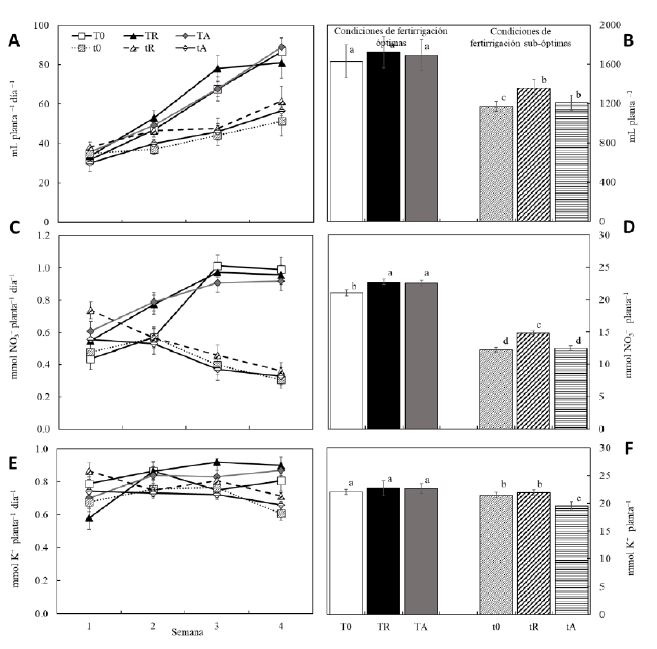
Figure 1. Weekly uptake of water, nitrate and potassium (A, C and E) and total uptake (B, D and F), respectively, by lettuce plants grown in a soilless substrate based on coconut fibre, under different fertigation regimes using biostimulants extracted from invasive algae (R. okamurae) and commercial algae (A. nodosum). T0 = nutrient solution, standard fertigation conditions; TR = T0 + RoB; TA = T0 + AnB; t0 = ½ nutrient solution, sub-optimal fertigation conditions; tR = t0 + RoB; tA = t0 + AnB. Different letters indicate statistically significant differences with a p-value < 0.05.

  • Composition and safety: The extract had an alginate content of 19.4% and a mannitol content of 7.9%, also complying with the limits for heavy metals assessed in accordance with Regulation (EU) 2019/1009.
  • Phytochemical quality: The treatment promoted the accumulation of compounds of nutritional interest, such as lutein, β-sitosterol and squalene, particularly under conditions of nutrient deficiency.

These results support the use of algal biostimulants as a sustainable alternative to conventional fertilizers, with the potential to increase crop yield and nutritional quality; however, further studies are required across a wider range of species, doses and applications systems to broaden their agricultural applicability.


Duration:
  • 2022/2025
Participating members
  • Interjospal 
  • University of Almeria 
Funding body